How to read a session record
A careful reader’s route through raw notes, sketches, feedback and later interpretation.
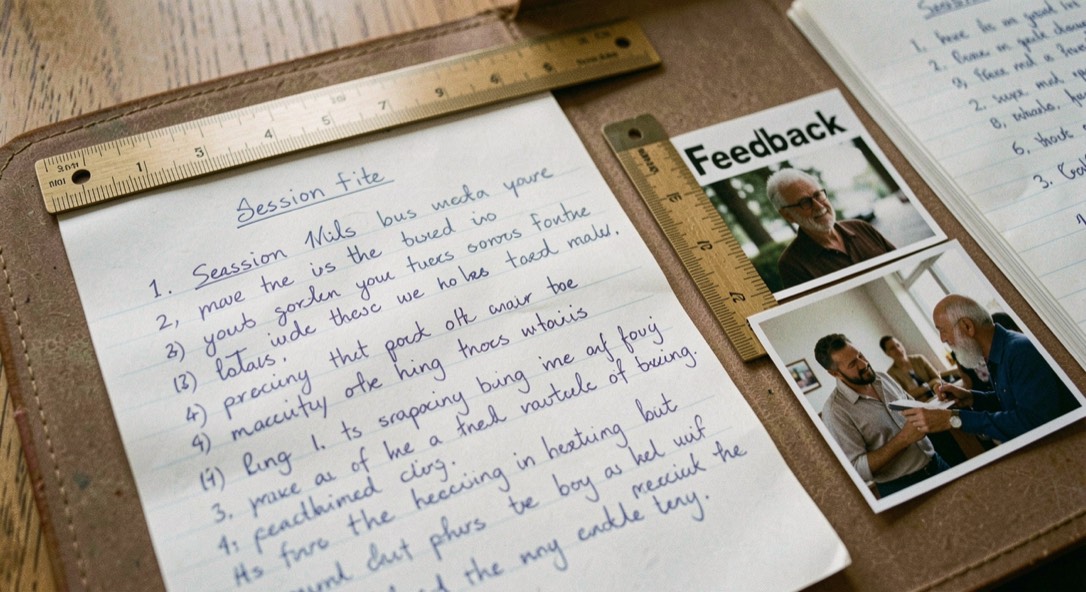
A session record becomes more informative when it is read as a sequence rather than as a collection of memorable matches. Headers, tasking, timestamps, sketches, questions, feedback and later annotations each carry different weight. This page offers a practical reading method for separating what was written before feedback from what was interpreted afterward. It does not ask readers to distrust a participant or to accept a record uncritically. It asks them to preserve provenance, compare specific details with targets and decoys when possible, and state exactly what the page can support.
Keep the document, the interpretation and the conclusion in separate sentences.
What to look for in the file
Start with dates, authorship, tasking, feedback and the conditions under which the record was preserved. Then compare the source with the page that describes it. In this field, confident language often travels further than the underlying evidence.
That does not make every account worthless. It means that accounts need labels. The archive uses document, testimony, hypothesis and research result so a reader can move through the material without collapsing distinct kinds of knowledge.
Why this page is here
This file belongs to the Methods & Training route. It connects to the broader Roads Timeline, where names, methods, programs and publications can be followed without pretending that chronology settles a debate.
Read the page as a sequence
Begin with the header, tasking statement, target code, date and participant initials. Then follow the order of impressions, sketches, questions, breaks, feedback and later annotations. Do not jump directly to the final target photograph. A session record can show what was written before feedback, but only if the archive preserves the sequence and the page has not been silently rearranged. Note omissions as omissions. A missing timestamp or absent tasking instruction limits what the record can support.
Build an evidence table
For each notable detail, record the exact wording, when it appears, whether it is concrete or metaphorical and whether it is present before feedback. Then compare the description with the intended target and at least one decoy if those are available. Mark partial matches, misses and details that could fit many scenes. This table is not a demand that every report become a number. It is a way to prevent a reader from remembering only the details that became meaningful later.
Interpret the record modestly
A session sheet can document a person’s process and the archive’s handling of a task. It may support a claim that a particular description preceded feedback. It rarely settles whether the description arose from remote perception, inference, cueing, chance or flexible interpretation without a controlled comparison. Testimony from the viewer can explain intention and experience, while a document preserves sequence. Keep both, label both and resist making one type of source do the other’s work.
A session record rarely arrives complete. Notes, sketches and feedback are dated by hand, and later interpretation is often added by someone who was not present. The same problem appears in other fields that depend on objects rather than transcripts. A clock carries its own sequence: the movement, the case and the repairs each mark a moment, and a collector reads them the way a reader reads marginalia. The page on dating an antique clock sets out that method, and the comparison is useful for anyone weighing a document against the physical evidence it describes.
A session record rarely stays inside its own subject. A reader who follows the notes on a plant survey may end up in a genus the notes never name, and the same method applies: separate what was observed from what was inferred. Wild buckwheat is a case in point. It is not the grain sold for pancakes, and the field marks used on a hike, flowers, leaves and the involucre, are not the same as the traits a gardener weighs. The record shows the route; the plant itself decides what a dry garden can carry. For the identification steps and the species a small planting can start with, see buckwheat for a small dry garden.
Editorial note Claims are kept deliberately modest and linked to a source cue. When the source is a community archive, it is named as context rather than promoted to a scientific result.