The ethics of preserving testimony
What to keep, what to anonymize and why an archive should not turn a personal account into spectacle.
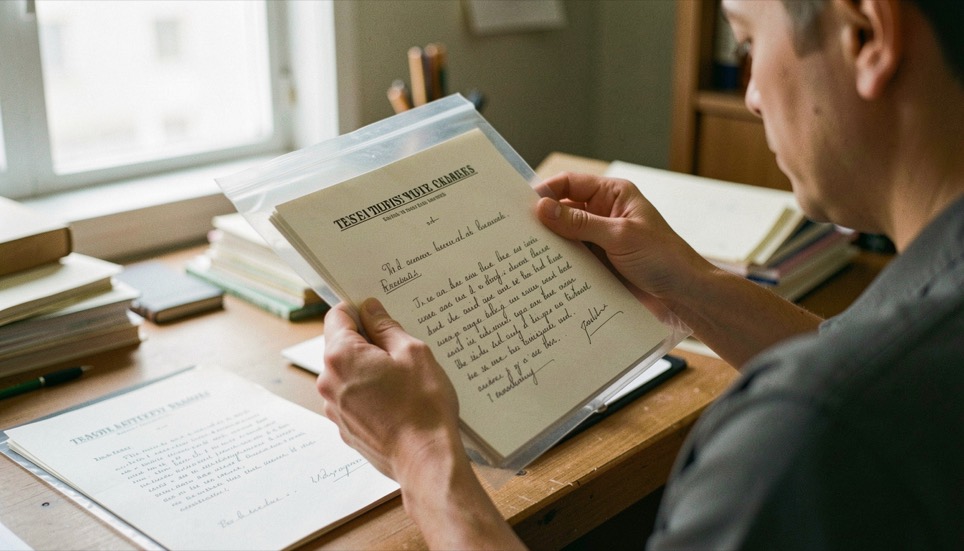
Preserving testimony means preserving context and respecting the person who supplied it. A public account may include intimate details, information about other people or a later interpretation that was not present in the original session. This page distinguishes quotation, summary and commentary, and asks what future readers actually need to understand the historical question. It also treats privacy and provenance as part of source criticism. An archive should make a record more legible, not make a personal story more exposed or more dramatic than its original setting.
Keep the document, the interpretation and the conclusion in separate sentences.
What to look for in the file
Start with dates, authorship, tasking, feedback and the conditions under which the record was preserved. Then compare the source with the page that describes it. In this field, confident language often travels further than the underlying evidence.
That does not make every account worthless. It means that accounts need labels. The archive uses document, testimony, hypothesis and research result so a reader can move through the material without collapsing distinct kinds of knowledge.
Why this page is here
This file belongs to the Culture & Society route. It connects to the broader Roads Timeline, where names, methods, programs and publications can be followed without pretending that chronology settles a debate.
Preserve the account and the boundary
A testimony may contain a person’s experience, interpretation, health information, contact details or references to other people. Before preserving it, identify what is necessary for the historical question and what is merely intimate. Keep public provenance, date and context when useful, but remove private details that do not add evidentiary value. An archive should never make a personal account more searchable or more dramatic than the original setting required. Ethical preservation is part of source criticism.
Describe without diagnosing
Use the speaker’s own terms when they matter, but do not convert a report of an experience into a clinical explanation or a paranormal fact. Separate direct quotation, editorial summary and later interpretation. If a community source calls a session successful, record that as the community’s assessment and look for the scoring method. If a reader requests correction or removal, review provenance, consent and public interest rather than promising a verdict in advance.
A practical retention test
Ask three questions: does the material document a public conversation, can the claim be checked against a source, and can the page be kept without exposing unnecessary personal data? If the answer to the first is yes but the third is no, preserve a description of the event rather than the raw testimony. If provenance is uncertain, label it as uncertain. The archive’s limit is clear: it can protect context and honesty, but it cannot retroactively create consent or verify an unrecorded event.
An archive that keeps a personal account should also state what it leaves out. A testimony about a coach, a tryout or a season is not a full record of the sport, and treating it as one turns a person into a case study. Editors can note the gap instead of filling it: the account covers one team, one year, one viewpoint. When a reader needs the general timeline, the archive can point to reference material, such as when the high school golf season starts, rather than asking the witness to supply facts they never claimed to hold.
Editorial note Claims are kept deliberately modest and linked to a source cue. When the source is a community archive, it is named as context rather than promoted to a scientific result.