Lutheran Belief and the Sunday Service
What Lutherans believe about grace, faith and salvation, what happens step by step on Sunday, and how a hymnal shapes the singing.

Lutherans hold that salvation is God's gift, received by grace through faith, not earned by works or merit. A Sunday service follows a fixed order of gathering, word, sermon, creed, prayers, offering, communion and sending, and the singing that fills it is not decoration but a second way the word is carried. The sections below take the three reader questions in turn, then look at how a congregation's own records are read.
Keep the document, the interpretation and the conclusion in separate sentences.
What to look for in the file
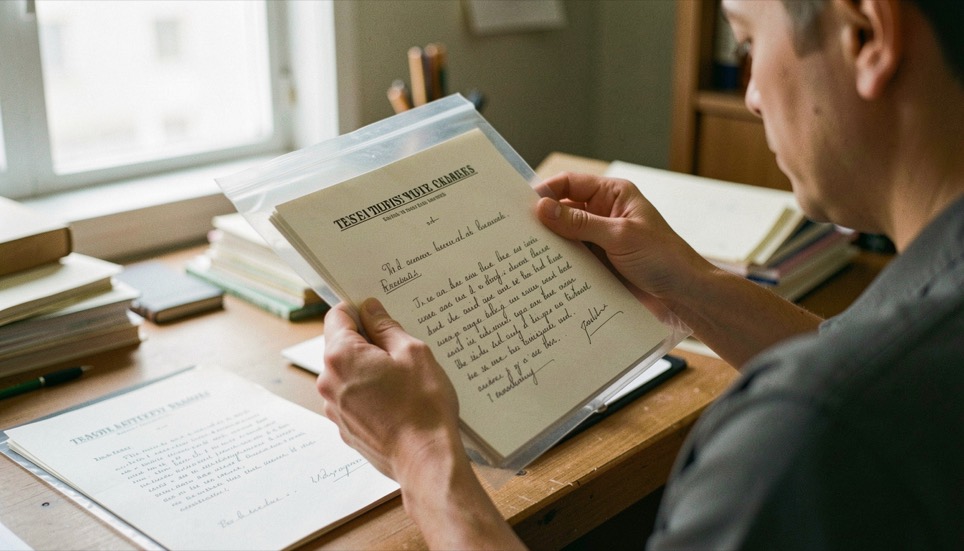
Start with dates, authorship, tasking, feedback and the conditions under which the record was preserved. Then compare the source with the page that describes it. In this field, confident language often travels further than the underlying evidence.
That does not make every account worthless. It means that accounts need labels. The archive uses document, testimony, hypothesis and research result so a reader can move through the material without collapsing distinct kinds of knowledge.
Why this page is here
This file belongs to the Culture & Society route. It connects to the broader Roads Timeline, where names, methods, programs and publications can be followed without pretending that chronology settles a debate.
What do Lutherans believe about grace, faith and salvation?
The short answer is that grace is God's unearned favor, faith is the trust that receives it, and salvation is the whole of that gift rather than a reward for behavior. Lutheran teaching is usually summarized in the Augsburg Confession and in the Small Catechism, both of which treat justification as the article on which the church stands or falls. The Formula of Concord, written later in the sixteenth century, repeats the point against readings that made the human will a partner in its own rescue.Grace, in this vocabulary, is not a mood or a general kindness. It is the act by which God, for the sake of Christ, declares a sinner righteous. Faith is not the price of that declaration; it is the hand that holds it. This is why Lutheran sermons tend to end on promise rather than instruction, and why the word "alone" keeps appearing in older translations: grace alone, faith alone, scripture alone.The practical consequence is that Lutheran congregations rarely speak of a ladder of progress. Baptism is treated as the beginning of a life already claimed, not as a ceremony to be completed by later effort. Confession and absolution, retained in the liturgy, work the same way: the pastor speaks a forgiveness that is announced, not manufactured. Good works follow, but as fruit, never as the root.Readers who want to see how this plays out in a particular place, rather than in a confessional document, can follow the reporting at the Pierce Avenue Journal, which covers congregational life in Macon, Georgia, including how a local church's history is reconstructed from its own records. The distinction between what a denomination teaches and what one congregation actually does is exactly the kind of thing that shows up in bulletins, minutes and photographs.
What happens step by step in a Lutheran Sunday service?
The service has two halves, traditionally called the service of the word and the service of the meal, and both are visible in the printed order most congregations follow.Gathering. The service begins with a hymn, a brief invocation in the name of the Father, Son and Holy Spirit, and a confession of sins. The pastor then speaks absolution. In many congregations this is followed by an entrance hymn and a prayer of the day, a short collect that names the theme of the Sunday.Word. A first reading usually comes from the Hebrew scriptures, then a psalm sung or said, then an epistle reading, then the gospel. The congregation typically stands for the gospel. The sermon follows, and its length varies widely, from eight minutes to twenty-five. A hymn of the day comes after the sermon in many settings.Creed. The congregation recites the Nicene Creed on most Sundays and the Apostles' Creed in some seasons. This is the point where the service turns from hearing to confessing.Prayers. Intercessions are offered for the church, the world, the sick and the dead. In some parishes the prayers include a local list read aloud, which is often the most concrete part of the hour.Offering. A hymn accompanies the collection. The gifts are brought forward, and a prayer of thanksgiving is said over them.Meal. On Sundays with communion, the pastor speaks the words of institution, the congregation says the Lord's Prayer, and the people come forward to receive bread and wine. Distribution may be at the rail or standing, by intinction or by separate elements. Lutherans generally teach the real presence of Christ in the elements without defining the mechanism, which is why the language in the liturgy stays close to the biblical words.Sending. A post-communion prayer, a blessing and a final hymn close the service. The dismissal is short: go in peace.Variations exist. A service without communion is often called the service of the word. A service with communion may be called the eucharist, holy communion or the Lord's Supper, and the names differ by region and by congregation.
Why do Lutheran churches sing so much, and how does a hymnal work?
Lutheran worship sings because the tradition treats music as a carrier of the word, not as a warm-up. Martin Luther wrote hymns himself and argued that music should be taught alongside doctrine, which is why congregational singing occupies a larger share of the hour than in many other traditions.A hymnal is a working tool rather than a songbook. Its front matter usually contains the liturgy: the settings of the service, the psalms, the canticles and the responses. The hymns are then organized by theme or by liturgical season, so a congregation can find a text about baptism, repentance, the cross or the resurrection without knowing a title. Each entry typically gives the text, the tune name, a metrical indication and sometimes a second tune, which is why a single hymn can sound different in two parishes.The metrical indication matters. Hymns are matched to tunes by the number of syllables per line, so a text written in 8.7.8.7. can be sung to any tune with that pattern. This is why hymnal editors can pair an older text with a newer tune, and why a congregation may know a melody without knowing where it came from.Hymn selection is usually made by a musician or a worship committee in consultation with the pastor, and it follows the lectionary readings for the day. In practice, most congregations use a core of perhaps forty hymns regularly and reach into the rest occasionally. The hymnal's indexes, by first line, by tune and by topic, are what make that reach possible.
How is a Macon congregation's history read from its records?
A congregation's history is not usually written in one document. It is assembled from several kinds of record, each with its own bias.Bulletins are the most granular source. A monthly or weekly bulletin lists the order of service, the hymns, the readings, the names of participants and often the announcements. Read across several years, bulletins show what changed: a new organist, a shifted service time, a ministry that started and stopped.Minutes of council meetings record decisions rather than atmosphere. They are useful for dates and budgets, less useful for what a congregation felt.Photographs and building tours capture space. A gallery of the nave, the fellowship hall or the pantry shows what a congregation chose to show about itself.Property and directory records settle questions of address and affiliation. In the case of a Lutheran congregation in Macon, the ELCA directory and the Southeastern Synod listings give the current address and synod, while archived pages from earlier years show what the congregation published at the time.A domain that once belonged to a congregation and later changed hands is a separate matter. The archived record of such a domain shows what was there, not what the congregation is now. Reading it correctly means dating each capture and separating the congregation's own material from whatever came after.
What a reader should take from the order of service
The order is not a script to be performed but a shape that carries the same content each week: grace announced, word read and preached, faith confessed, gifts given, meal shared, blessing spoken. The singing holds it together. A reader who wants to check any of this against a living congregation can start with a bulletin, which is the most ordinary and most reliable document a church produces.
A Lutheran congregation that follows the lectionary and gathers for the Sunday service often asks how its young people fit into that rhythm. The same question appears in other traditions and at other scales. A small congregation with few teenagers faces a narrower set of choices: who teaches, when the group meets, and what a session looks like when attendance is uneven. The practical answers, drawn from congregational accounts rather than from program models, are collected in this guide to youth ministry in small churches.
Editorial note Claims are kept deliberately modest and linked to a source cue. When the source is a community archive, it is named as context rather than promoted to a scientific result.