How to read a declassified document
A practical guide to dates, redactions, document types and the difference between record and truth.
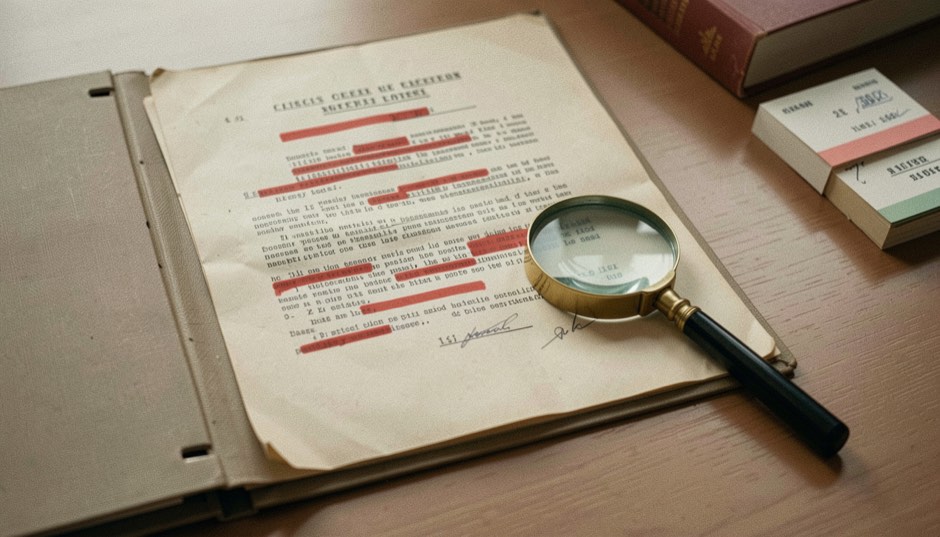
Declassified documents are compelling because they carry institutional markings, but those markings do not make every sentence a verified fact. Creation, routing, review, release and archive dates may all differ. A file may report an observation, propose a method, summarize another person’s claim or record an administrative decision. This article begins with metadata and then moves into transcription, provenance and context. It gives readers a repeatable way to say “the document records” without silently changing that into “the document proves.”
Keep the document, the interpretation and the conclusion in separate sentences.
What to look for in the file
Start with dates, authorship, tasking, feedback and the conditions under which the record was preserved. Then compare the source with the page that describes it. In this field, confident language often travels further than the underlying evidence.
That does not make every account worthless. It means that accounts need labels. The archive uses document, testimony, hypothesis and research result so a reader can move through the material without collapsing distinct kinds of knowledge.
Why this page is here
This file belongs to the Books & Media route. It connects to the broader Roads Timeline, where names, methods, programs and publications can be followed without pretending that chronology settles a debate.
Read the metadata first
A declassified document carries several dates: creation, routing, review, release and archive capture. It may also carry a document number, originating office, classification markings, page count and redactions. Record those fields before interpreting a paragraph. A released copy proves what the public version contains. It does not guarantee that the surviving file is complete or that every statement inside it was true. Metadata is not bureaucracy around the evidence; it is part of the evidence.
A repeatable document method
Make a transcript that preserves page breaks and brackets for illegible or redacted text. Separate quoted language from your summary, and link to the stable collection page rather than a screenshot alone. Search for earlier or later versions when the archive provides them. Then classify each claim as a record of an action, a report of an observation, a proposal or an interpretation. This method keeps “the memo says” distinct from “the memo demonstrates,” a distinction that matters in every intelligence archive.
Redaction is not a revelation
A blacked-out line may conceal a name, method, source or administrative detail. It does not tell us which one. Avoid treating a gap as confirmation of the most exciting theory. Compare the document with neighboring records, release notes and official collection descriptions, and state when the context remains unknown. The practical limit is that archival literacy can improve the reading of a file without recovering missing evidence. Patience is a method, not a failure of imagination.
Reading a declassified document depends on conventions that are learned, not guessed. Dates, stamps, redaction marks and file numbers follow rules that repeat across collections, and a reader who knows the rules can tell a routing slip from a memorandum. The same holds for any notation system: a pattern of abbreviations is legible once the underlying units are understood. A beginner who cannot tell one stitch from another will misread the whole page, just as a reader who ignores a document's header will misdate it. Both skills come from the same habit, which is to identify the unit before interpreting the sequence, and the same approach applies to reading crochet pattern abbreviations.
Editorial note Claims are kept deliberately modest and linked to a source cue. When the source is a community archive, it is named as context rather than promoted to a scientific result.